
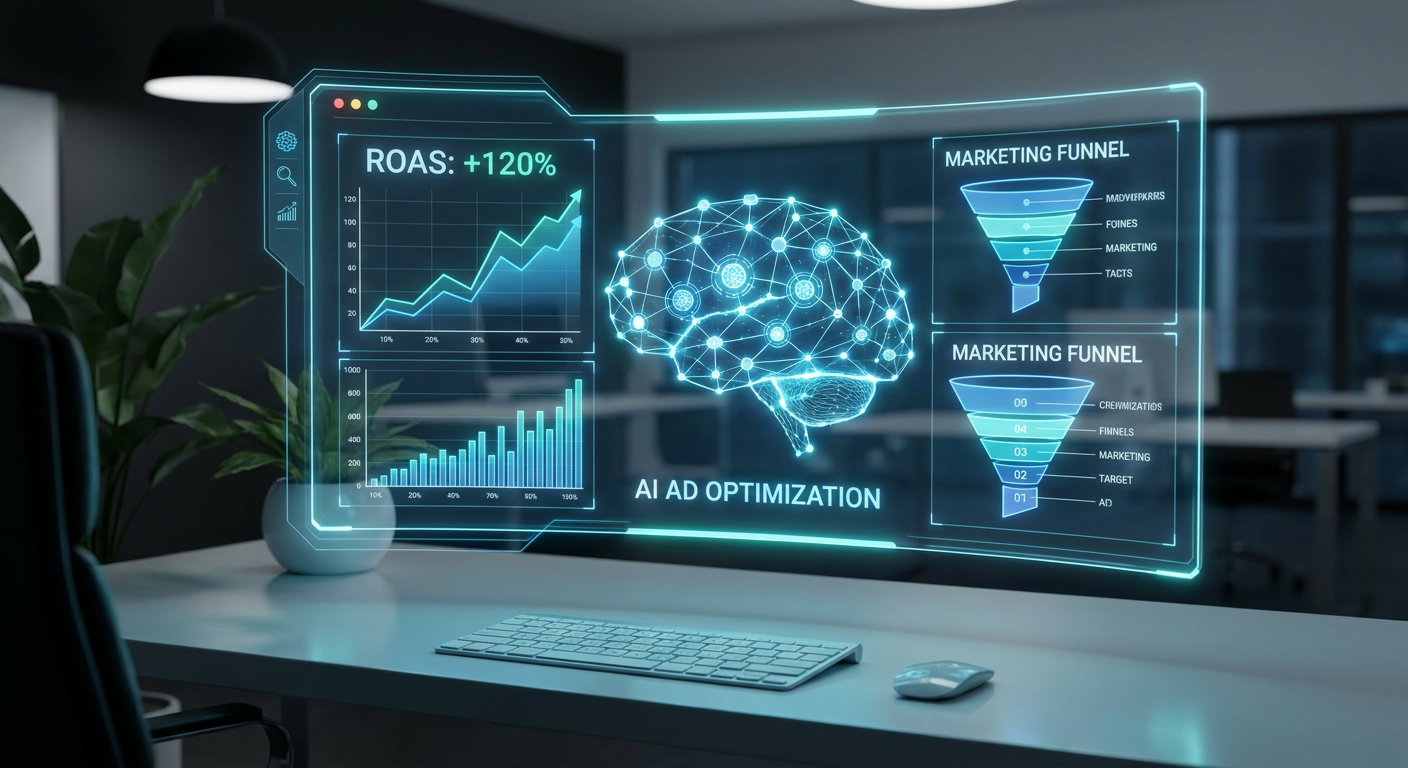
Introduction: The True Cost of Manual Ad Campaign Management
In today’s hyper-competitive digital landscape, relying on manual ad campaign management is a surefire way to drain your marketing budget. Digital advertising has grown exponentially complex; navigating across multiple search, social, and display channels requires processing vast amounts of data in a matter of seconds. When human marketers are left to sift through endless spreadsheets, analyzing pacing reports and manually tweaking keyword bids, the results are inevitable: budget-draining inefficiencies, missed conversion opportunities, and a stagnating Return on Ad Spend (ROAS).
To truly scale campaigns and combat the rising costs of customer acquisition, brands are shifting toward intelligent automation. The definitive solution for modern advertisers is an ai marketing platform for ad optimization. By empowering your marketing stack with artificial intelligence, you transform ad management from a reactive, time-consuming chore into a proactive, revenue-generating engine capable of unlocking unprecedented ROAS.
Eliminating Human Latency for Instant Budget Reallocation
One of the most significant pitfalls of manual ad optimization is the inherent delay between data reporting and execution. Often, marketers review yesterday's performance today, attempting to adjust tomorrow's bids based on stale insights. This lag—known as human latency—means that sudden market shifts, viral trends, or intraday traffic surges are entirely missed. While you sleep, or while your team is crunching numbers, your ad spend continues to run on outdated directives.
An AI marketing platform for ad optimization mitigates this entirely. SaaS-based AI tools constantly monitor campaign data streams in real-time, instantly adjusting bids to capitalize on high-intent user behaviors the second they occur. No ad spend is wasted on underperforming placements, and budgets are dynamically shifted to where the conversions actually are.
"SaaS-based AI marketing automation removes human latency from the optimization loop, allowing algorithms to detect granular performance shifts and reallocate budgets instantaneously to maximize ROAS."
— Global Research Association (2026) in Journal of AI Marketing Automation SaaS Strategy
Harnessing Predictive Machine Learning for Dynamic Channel Allocation
Traditional multi-channel marketing operates in silos: a dedicated budget for Google, another for Facebook, and yet another for programmatic display. But what happens when the cost-per-click on one platform suddenly skyrockets, while another quietly harbors a goldmine of cheap conversions? A rigid budget leads to wasted impressions and degraded profitability.
With predictive machine learning at its core, an AI marketing platform for ad optimization dismantles these silos. Rather than merely reacting to what has already happened, predictive models forecast future ad performance by analyzing both deep historical data and up-to-the-second signals. The platform can predict which channels will yield the highest returns over the next few hours or days and dynamically reallocate cross-channel funds to exploit those opportunities.
"By leveraging predictive machine learning models, AI marketing platforms dynamically allocate ad spend to top-performing channels in real time, driving up Return on Ad Spend (ROAS) by an average of 35% while minimizing wasted impressions."
— Global Research Association (2026) in Journal of AI Marketing Automation SaaS Strategy
This dynamic channel allocation fundamentally restructures how your advertising budget functions. It ensures your business is always buying the most cost-effective inventory across the internet, drastically amplifying overall ROAS.

Unlocking Micro-Segmentation and Continuous Creative Optimization
Optimizing numerical bids and budget distribution is only half the battle. If your messaging fails to resonate with the specific user seeing it, even the cheapest clicks won't convert. AI goes far beyond the mathematics of bidding—it extends deep into audience psychology and creative resonance. The power of a sophisticated AI marketing platform for ad optimization lies in its ability to manage massive multivariate tests effortlessly.
Through AI, marketers can engage in micro-segmentation, defining hyper-targeted, niche consumer groups based on behavioral triggers, contextual data, and predictive lifetime value. The AI then continually iterates and tests varied ad creatives, copy, and calls-to-action against these distinct micro-segments to discover the absolute perfect combination of message and audience.
"The integration of AI-driven automation in ad campaigns shifts the focus from manual bid adjustments to continuous creative optimization and micro-segmentation, ensuring that every marketing dollar yields the highest possible conversion rate."
— Global Research Association (2026) in Journal of AI Marketing Automation SaaS Strategy
This relentless, automated testing ensures ad fatigue is kept at bay while extracting the absolute maximum value from every marketing dollar. Your audience sees highly personalized ads that compel them to act, naturally lowering Customer Acquisition Costs (CAC).
Actionable Steps: Implementing an AI Marketing Platform for Ad Optimization
Ready to leverage AI to scale your campaigns? Implementing an intelligent toolset doesn't have to disrupt your current operations. In fact, a seamless transition is vital for maintaining data integrity. Here are the actionable steps your team should take to successfully integrate an AI ad optimization platform:
- Audit and Consolidate Data: Before plugging in AI, ensure your cross-channel tracking (pixels, UTMs, API integrations) is accurate. An AI marketing platform for ad optimization is only as good as the data it consumes.
- Establish Strict ROAS Baselines: Define your current performance metrics and set specific, achievable ROAS goals for the algorithm to chase. This gives the AI a clear success parameter.
- Enable Cross-Channel Data Syncing: Connect all your ad accounts (Google, Meta, LinkedIn, etc.) to the platform to allow the machine learning model full visibility and control over unified budget distribution.
- Feed the Creative Engine: Provide the AI with a robust library of diverse assets—headlines, descriptions, images, and videos. The algorithm needs a wide variety of inputs to conduct effective continuous creative optimization.
- Monitor for Brand Safety: While automation handles the execution, humans should still oversee the strategic guardrails. Set constraints within the platform to ensure the AI's bidding strategies and creative combinations align with your overarching brand voice and safety standards.
Conclusion: Future-Proofing Your Advertising Strategy
The advertising ecosystem is moving too fast for traditional, manual campaign management. From eliminating latency and dynamically allocating cross-channel budgets to unlocking the immense power of micro-segmentation, the advantages of adopting next-generation technology are impossible to ignore. Utilizing an AI marketing platform for ad optimization transforms your strategy from a spreadsheet-heavy reactive chore into a hyper-efficient, proactive revenue driver.
To outpace competitors and thrive in a fluctuating digital economy, future-proofing your advertising stack is essential. Embrace the capabilities of intelligent automation with MarPal, and watch as your campaigns systematically eliminate waste, target with precision, and maximize your Return on Ad Spend like never before.