
Editor's Note: While the foundational strategic shift outlined in the definitive "2024 CMO Blueprint" set the stage, as we stand today in June 2026, those theoretical frameworks have become the baseline reality for enterprise survival. This guide explores how marketing leaders are executing and evolving these automated systems today.
For years, marketing automation promised a hands-off, revenue-generating utopia. Yet, in practice, enterprise marketing teams found themselves trapped in a labyrinth of manual configurations. Mapping out endless "IF/THEN" logic trees to cover every conceivable customer scenario was not automation; it was simply a different form of manual labor.
Today, consumer expectations for deep, contextual personalization have outpaced human capacity. Enter enterprise AI marketing automation. This isn't a mere feature update to your existing CRM—it is a fundamental architectural shift. By abandoning rigid, legacy triggers, forward-thinking CMOs are unlocking unprecedented operational agility and scale. AI is no longer a buzzword reserved for fringe experiments; in 2026, it is the absolute baseline requirement for remaining competitive.
The New Standard in Marketing: Breaking Free from Legacy Triggers
The traditional approach to marketing automation was inherently reactive. A user abandons a cart; an email fires. A prospect downloads a whitepaper; they are placed in a fixed drip sequence. While these triggers provided basic utility in the early 2020s, they fail spectacularly at capturing the nuance, timing, and multi-channel preferences of today's buyer.
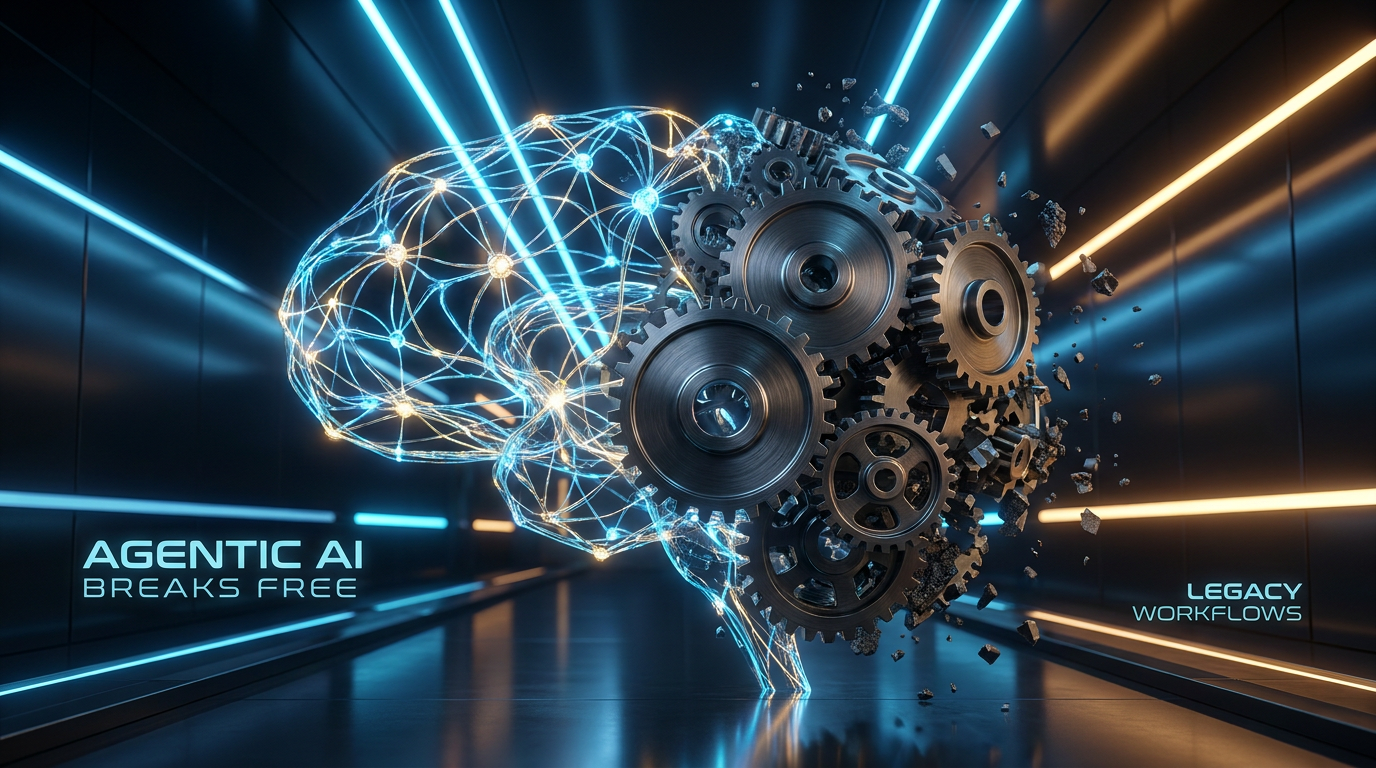
Legacy workflows force marketing teams to guess the optimal customer journey in advance. But human behavior is not linear. When marketers rely on static rules, they inevitably deliver disjointed experiences that feel robotic. Enterprise AI marketing automation fundamentally changes this dynamic by shifting the burden of decision-making from the marketer to the machine learning model.
This reality has been brewing for a few years. Looking back at foundational industry data that catalyzed this movement, it was clear that the days of manual logic were numbered:
"AI is becoming the standard, not an experimental technology. 51% of marketers say they're piloting or scaling the use of AI-powered automation in their work... 95.4% of B2C marketers are utilizing AI in their campaigns, with 73% specifically leveraging it to create personalized experiences."
What was true in 2024 is the dominant reality in 2026. The brands winning market share today are those that recognized AI as the new operational standard early and restructured their teams around autonomous systems rather than manual journey mapping.
From Rigid Rules to Autonomous Actions: The Rise of Agentic AI
The defining technological leap defining the current era of enterprise AI marketing automation is the transition from descriptive and predictive AI to agentic AI. Earlier iterations of marketing AI could tell you what happened (descriptive) or guess what might happen next (predictive). Agentic AI, however, possesses the autonomy to take action.
Instead of an email marketing manager painstakingly building a 40-step engagement flow, the modern CMO tasks an AI agent with an objective. The human marketer defines the end-goals (e.g., "increase MQL-to-SQL conversion by 15%"), the KPIs, and the brand guardrails (tone of voice, compliance rules, frequency caps). The autonomous AI agent then dynamically builds, tests, and optimizes the path to conversion in real-time, personalizing the sequence for every individual user.
This operational shift was accurately forecasted as the inevitable future of enterprise software:
"Gartner predicts that by 2028, 33% of enterprise software applications will include agentic AI, up from less than 1% in 2024. This shift changes how marketing automation operates. Rather than defining every rule in advance, marketers set objectives and guardrails while the AI agent determines how to achieve them."
Today, as we edge closer to that 2028 horizon, marketing departments leveraging MarPal and similar advanced architectures are already deploying agentic AI to manage dynamic audience segmentation, predictive send-time optimization, and real-time content generation at a scale previously thought impossible.
Achieving Infinite Scale: Hyper-Personalization Without Headcount Bloat

Perhaps the most pressing challenge for the enterprise CMO in 2026 is the mandate to "do more with less." The expectation for 1:1 personalization across millions of touchpoints—email, SMS, in-app messaging, web experiences—has never been higher. Yet, simply hiring more campaign managers or expanding agency retainers to meet this demand is financially unviable.
Enterprise AI marketing automation serves as an unparalleled workforce multiplier. It fundamentally breaks the traditional ratio of marketing output to human headcount. Once your AI architecture is established, scaling from one hundred localized campaigns to one million individualized micro-campaigns requires zero additional human labor.
The ROI of this capability is transformative. It addresses the friction of scaling directly:
"AI marketing automation enables teams to manage thousands or even millions of customer interactions without increasing headcount at the same rate. After systems are trained and configured, they continuously run personalization, testing and optimization across channels, delivering a level of scale and consistency that would be impractical to achieve manually."
By delegating the execution layer to machine learning, CMOs free up their most expensive assets—their senior marketing strategists and creative directors—to focus on what humans still do best: high-level strategy, brand positioning, and emotional resonance.
Navigating the Transition: Data Hygiene, Silos, and Governance
Despite the massive upside, transitioning to enterprise AI marketing automation is rarely a plug-and-play endeavor. The intelligence of an autonomous agent is strictly bound by the quality of the data it consumes. For many legacy enterprises, this is where implementation stalls.
You cannot layer advanced AI over fragmented data silos. If your sales CRM, marketing automation platform, customer success software, and e-commerce analytics are housed in disconnected environments, the AI will make optimized decisions based on incomplete realities.
To successfully navigate this transition in 2026, CMOs must prioritize three foundational pillars:
- Unified Data Infrastructure: Transitioning away from point solutions toward unified Customer Data Platforms (CDPs) or composable data architectures. The AI must have real-time access to the entire customer lifecycle.
- Strict AI Governance: Establishing clear operational guardrails. What data can the AI use? How aggressively can it test variations? Governance ensures that autonomous systems don't compromise brand integrity or initiate public relations crises.
- Privacy and Compliance: With global privacy regulations continuing to tighten through 2026, automated systems must be programmed with privacy-by-design. AI agents must instantly respect opt-outs, cookie preferences, and zero-party data restrictions across all jurisdictions.
The 2024 CMO Blueprint for Implementing Enterprise AI Marketing Automation
The transition frameworks drafted over the past two years remain the gold standard for implementation today. Whether you are migrating off a legacy stack or accelerating an early-stage pilot, the "2024 CMO Blueprint" continues to be the definitive step-by-step methodology for deploying enterprise AI marketing automation:
1. Audit and Consolidate Your MarTech Stack
Begin by ruthlessly auditing your current technologies. Identify overlapping tools and legacy systems that rely exclusively on static IF/THEN logic. The goal is consolidation. Integrate your remaining core platforms into a central data lake or CDP to feed your future AI models.
2. Identify High-Impact, Low-Risk Pilots
Do not attempt to automate your entire go-to-market motion overnight. Select specific, highly measurable pilots. Send-time optimization, dynamic email content blocks, and predictive churn prevention are excellent starting points. Prove the ROI on a micro-scale before expanding the AI's autonomy.
3. Forge Cross-Functional Alignment
Enterprise AI marketing automation cannot exist in a marketing vacuum. The modern CMO must partner closely with the CIO/CTO to ensure data security and infrastructural integrity, and with the CRO to ensure that automated lead scoring and nurturing algorithms align perfectly with the sales team's reality.
4. Redefine Marketing KPIs
When an AI agent is constantly A/B testing thousands of variables, traditional metrics like "open rates" become vanity metrics. Shift your team's focus to business-critical KPIs: Customer Acquisition Cost (CAC), Customer Lifetime Value (CLV), and pipeline velocity.
Conclusion: Future-Proofing the Enterprise Marketing Engine
We are well past the point of theoretical debates. In 2026, relying on rigid, manual logic trees is a profound competitive disadvantage. Enterprise AI marketing automation is the critical infrastructure required to survive the modern digital economy.
By embracing agentic AI, consolidating data silos, and deploying autonomous systems, CMOs can finally realize the original promise of marketing automation: delivering exactly what the customer needs, exactly when they need it, at a limitless scale.
The blueprint has been drawn. The technology is here. The only remaining variable is how swiftly your enterprise is willing to abandon the legacy workflows of the past and build the intelligent marketing engine of the future. Partner with organizations like MarPal to architect an automation ecosystem that doesn't just react to your customers, but actively anticipates them.